Tomokazu Komiya Pokémon Cards: An Artwork Collector’s Guide
Identify six Tomokazu Komiya Pokémon cards, from Neo-era Ledyba to Drowzee and Brute Bonnet. Compare the artwork and plan an artist collection.
Quick answer
Table of Contents
Key takeaways
- Recognizing the artwork
- Six exact cards for your checklist
- What to look for in each picture
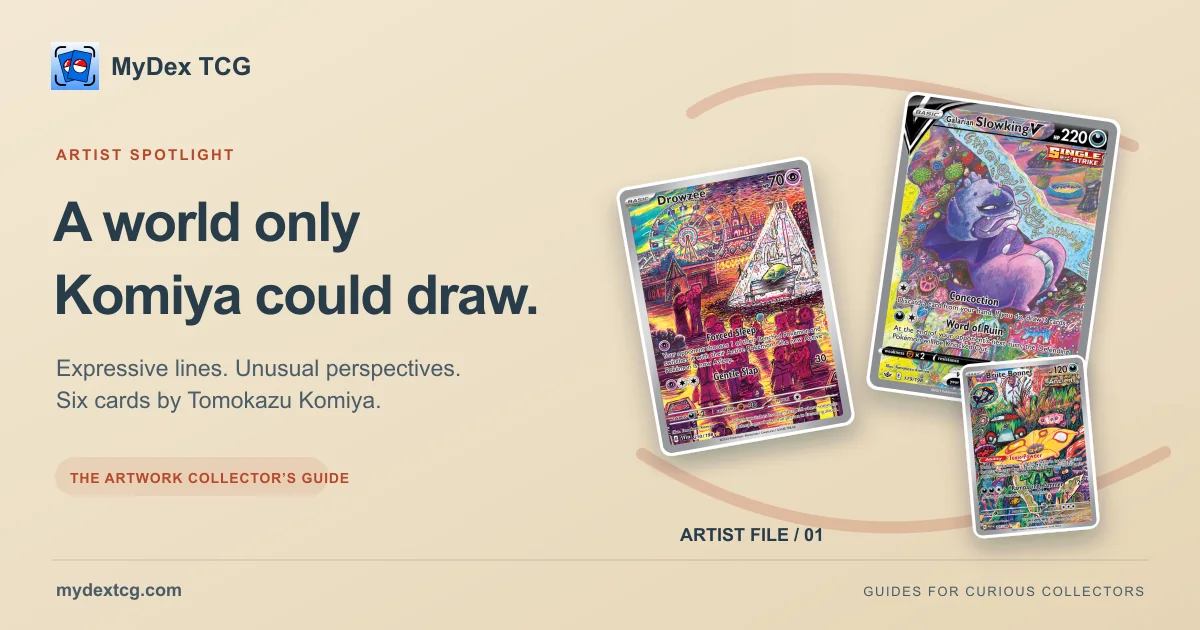
Tomokazu Komiya's Pokémon cards give an artist collection plenty of variety: a crying Ledyba in a small illustration window, a sleeping Drowzee surrounded by a crowded fairground, and a forest that almost hides Brute Bonnet. The connection is the illustrator, so you can collect across Pokémon species and expansions.
Start with the Tomokazu Komiya illustrator credit and the exact collector number. A Pokémon's name alone will not identify the artwork. The six English printings below provide a manageable starting checklist.
Recognizing the artwork
In his official conversation with fellow illustrator Kouki Saitou, Komiya describes working primarily with acrylic gouache and adding marks with pencils, colored pencils, ballpoint pens and markers. He explains that markers help him achieve stronger black lines on paper. That describes his practice; it does not establish the exact materials used for every individual card.
Across the examples here, compare the expressive eyes, irregular contours and colors that run through both the Pokémon and its surroundings. These are useful visual clues, but the printed credit is the reliable identification check. The observations below describe what is visible in the images; mood and narrative readings are interpretations.
Six exact cards for your checklist
| Card | English collector number | Expansion | Detail to compare |
|---|---|---|---|
| Delibird | 5/64 | Neo Revelation | Forward lean and sweeping head feathers |
| Ledyba | 71/105 | Neo Destiny | Tears and a tight grip on the rock |
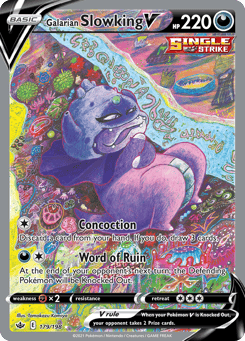
| Galarian Slowking V | 179/198 | Chilling Reign | Diagonal pose and patterned surroundings |
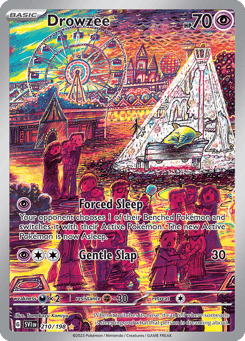
| Drowzee | 210/198 | Scarlet & Violet | Quiet sleeper against a crowded fairground |
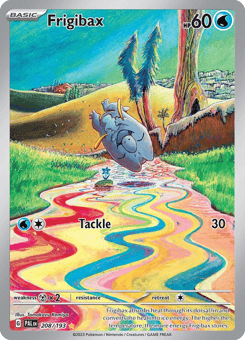
| Frigibax | 208/193 | Paldea Evolved | Airborne pose over winding bands of color |
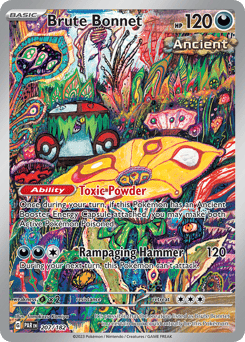
| Brute Bonnet | 207/182 | Paradox Rift | Pokémon partly concealed by oversized plants |
All six printings credit Komiya. Keep the complete numbers when searching: 179/198 identifies this Galarian Slowking V illustration, while 210/198 identifies the Drowzee shown above.
What to look for in each picture
Delibird leans forward with one foot lifted, its white head feathers stretching across the illustration. The sloping ground reinforces that sense of movement. Its large, sideways-looking eyes make the expression readable even within the smaller Neo-era picture window.
Ledyba grips a tall rock with round white hands while tears hang beneath its eyes. Yellow-green foliage presses against the dark blue background. Komiya names this Neo Destiny illustration as a personal favorite in the official interview, making it an especially interesting comparison with his later work.
Galarian Slowking V fills the card diagonally. Look past the large purple headpiece and pink body to the pale band of symbols behind them, then the small patterned shapes around the edges. The picture rewards looking away from the central Pokémon and returning to it.
Drowzee sleeps on a bench beneath a pale triangular structure, with a Ferris wheel and red-toned figures nearby. The resting Pokémon contrasts with the dense, energetic setting. It can feel like an uneasy dream, but that is a reading of the composition, not a confirmed explanation of the scene.
Frigibax hangs above a stream whose red, yellow and blue bands wind toward the foreground. A tiny flower, distant house and tall trees give the scene several scales to compare. Its open landscape offers breathing room beside the denser Drowzee and Slowking pictures.
Brute Bonnet sits behind a large yellow foreground plant. Repeated circles, jagged leaves and bright outlines compete for attention around it. Pokémon's official expansion preview also draws attention to the Pokémon hiding in this colorful forest. Try locating its face before following the surrounding shapes.
Plan an artist collection you can track
Decide what a completed slot means before expanding the checklist. One copy of each distinct illustration is a different goal from collecting every language, edition, stamp or finish. Record those choices separately so a second printing does not accidentally become a missing artwork.
A useful record includes the card name, expansion, full number, language, finish, condition and whether you own it. For older cards, check the edition marking as well. The image supplied for an online listing may be a stock photograph, so inspect photographs of the offered copy when condition matters.
Arrange these six chronologically to compare the smaller Neo-era picture windows with later artwork that extends across the card. Alternatively, group them by mood or color. Their shared illustrator does not mean their borders form a continuous scene; the Crown Zenith nine-card mosaic is a different kind of collection project.
Use the linked card pages to compare available prices for the exact printing. Keep raw copies separate from graded ones, and include shipping in your spending limit.
Methodology
Sources
Related Tools & Next Steps
Track the Cards You Research
The web is great for quick answers. The app is where you scan cards, track value, and manage the collection you actually own.
Download MyDex TCG