Pokémon 151 Master Set Checklist & Binder Plan
Plan an English Pokémon 151 master set: download a 207-card checklist, track reverse holos and promos separately, and calculate your binder space.
Quick answer
Table of Contents
Key takeaways
- Start with the 207-card checklist
- Decide what your 151 master set includes
- Reverse holo versus illustration rare: check the number first
Start with the 207-card checklist
Download the 207-card binder checklist (CSV)Open the file in a spreadsheet and save your own working copy. It contains one row per English MEW card number, with the card name, a nine-pocket binder position, ownership and finish fields, notes, and a link to the exact card. Ownership fields start blank. The first row is Bulbasaur 001; the last is Basic Psychic Energy 207.
The numbers follow the official Pokémon checklist. The printed denominator is 165, but the sequence continues through 207/165. That makes 207 numbered entries, including 42 above 165. It does not mean there are only 207 physical versions to collect.
Use the complete English 151 card catalog to browse all the illustrations. This guide turns that numbered list into a collecting plan: what counts as complete, where each copy goes, and how to record what is missing.
Decide what your 151 master set includes
Write a scope statement at the top of your spreadsheet. “Every English numbered card, plus the parallel foils I list, with promos in a separate section” is useful. “Complete 151” leaves too many decisions unresolved.
| Collecting goal | What you track | What still needs a decision |
|---|---|---|
| Numbered set | One copy of each of the 207 numbers | Which finish satisfies a row where alternatives exist |
| Numbered set plus parallel foils | The numbered list and a separate row for each additional finish you want | Confirm which finishes exist; do not duplicate every row automatically |
| Expanded master set | Your numbered and finish lists, plus explicitly selected extras | Product promos, stamps, Basic Energy variants, metal cards and oversize cards |
There is no single total supplied by these official sources for every collector's definition of “master set.” The checklist establishes the numbered cards; product announcements establish additional cards. Your written inclusion rules determine the final target.
Use this setup checklist before buying anything:
- Set the language to English and keep other languages on a separate sheet.
- Decide whether each numbered row needs its standard printing, or whether an existing parallel copy can satisfy your first milestone.
- Add separate rows for additional finishes you intend to collect.
- Write down which promos and stamps are included, and which are outside your project.
- Choose a condition standard you will accept and note any exceptions.
- Count the resulting rows, reserve space, and set a spending limit.
Reverse holo versus illustration rare: check the number first
Collectors commonly call parallel foil cards reverse holos. Pokémon's Scarlet & Violet appearance guide describes foil around the illustration and an expansion-code box with black text on white, instead of the usual white text on black. Inspect the physical card under changing light; a flat image can hide the finish.
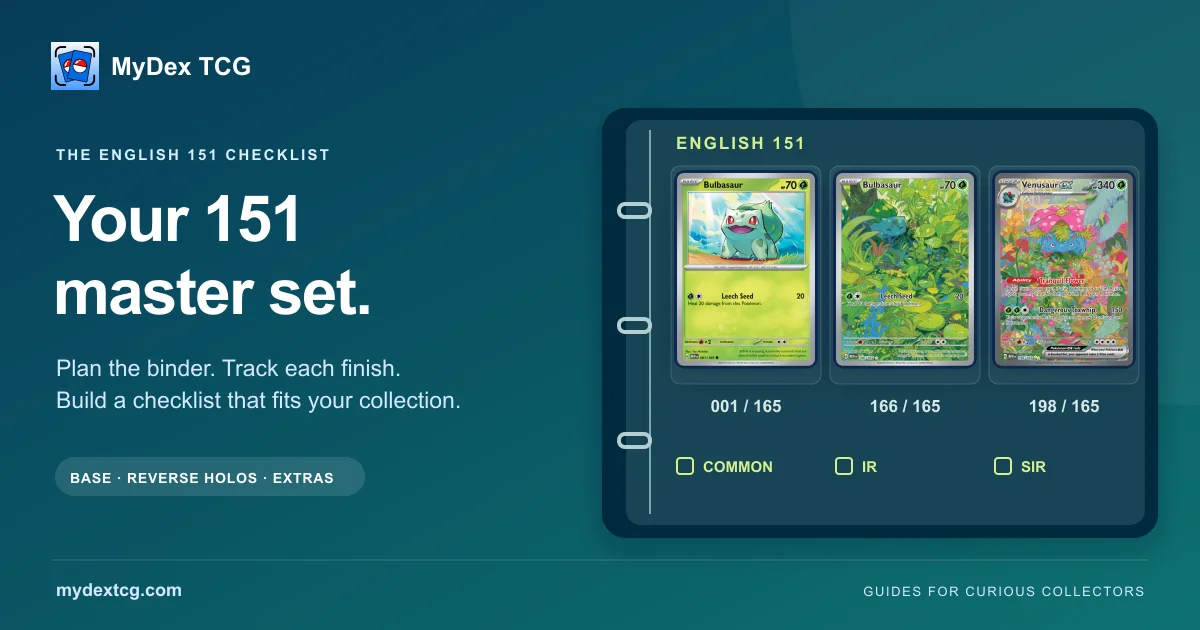
An illustration rare is a different numbered card, not the reverse-holo version of the ordinary illustration. The two Bulbasaur cards below make that distinction easy to record.
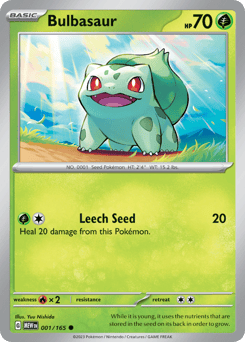
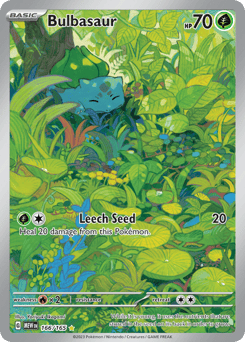
These catalog images identify Bulbasaur 001/165 and Bulbasaur 166/165. They compare artwork and numbering; they are not photographs demonstrating standard versus parallel foil on the same number.
| Example | What identifies it | Checklist treatment |
|---|---|---|
| Bulbasaur 001/165 | Common; black circle rarity mark | Record the actual finish. An additional parallel copy gets its own row if included. |
| Bulbasaur 166/165 | Illustration rare; one gold star | Its own numbered row, separate from 001 |
| Venusaur ex 003/165 | Double rare; two black stars | Its own numbered row; shiny does not automatically mean reverse holo |
On these English cards, check MEW, EN, the complete collector number and the rarity mark together. The Pokémon name alone is insufficient. The card-symbols guide explains how to locate those details.
The official checklist's legend distinguishes standard cards from standard foil cards. It is not an exhaustive reverse-holo or promotional-variant tracker. Keep “finish unconfirmed” in your notes until you have identified the actual printing, rather than marking an assumed variant missing.
Which promos and product variants should you add?
Choose extras individually. These official product examples show why two collectors can finish different lists:
| Product or promotion | Documented example | Decision for your checklist |
|---|---|---|
| 151 Elite Trainer Box | Snorlax promo | Include or exclude the promo section |
| Pokémon Center 151 Elite Trainer Box | Two Snorlax copies, one with the Pokémon Center logo | Track the logo version separately if you collect stamps |
| 151 Poster Collection | Three Kanto first-partner Pokémon promos | Add three rows if this group is in scope |
| 151 Ultra-Premium Collection | Mew ex promo, Mewtwo promo and a metal Mew ex card | Separate ordinary cards from the metal collectible |
| 151 Alakazam ex and Zapdos ex collections | Additional foil cards; the Zapdos product also has an oversize card | Identify each printing and plan suitable storage |
These contents are documented in Pokémon's 151 launch announcement. “Promo” in a product description is not a substitute for recording the card's own printed identifier and finish.
Regional promotions are another boundary. Pokémon's original announcement described Charmander promotions at GameStop in the US and Canada and EB Games in Australia and New Zealand, and a Bulbasaur promotion at Best Buy in the US. That is historical distribution information, not a claim that those offers are available today. Record the specific version and source before adding a retailer promo to your target.
These examples are not a complete inventory of every promotional printing. Add a source link alongside each extra you choose, especially if a seller advertises an unfamiliar stamp or foil treatment.
How many binder pockets do you need?
Count usable pockets, with one card per pocket. A nine-pocket side is one visible 3-by-3 face; it is not necessarily what a manufacturer means by a “page.” Check the binder's stated total capacity.
Use this calculation:
Required pockets = 207 numbered cards + additional finish copies + selected extras + deliberately empty spaces.
Count each physical copy once. If a parallel foil already occupies a numbered slot, only the other copy you add increases the total. Divide the required pockets by nine or twelve, then round up to obtain the number of sides.
| Explicit example | Pockets needed | Nine-pocket sides | Twelve-pocket sides |
|---|---|---|---|
| One copy per number, no extras or gaps | 207 | 23 | 18 |
| The numbered set plus the three Poster Collection promos | 210 | 24 | 18 |
| Those 210 cards plus six reserved empty pockets | 216 | 24 | 18 |
The second and third rows are planning examples, not complete master-set totals: they do not allocate extra parallel foils or other promos. Increase the count when your scope includes them. Metal and oversize cards need an appropriate storage decision rather than an assumed standard pocket.
Pokémon lists the official 151 Binder Collection album at 360 cards in its launch announcement. After 207 numbered copies, that leaves 153 pockets. That is spare capacity, not evidence that every extra you want will fit. A ledger requiring 361 pockets already exceeds it.
For a layout that preserves the download's positions, keep numbers 001–207 first and place extras after them. If you prefer standard and parallel copies next to each other, insert the extra rows first and recalculate every later position. Leave labeled placeholders for missing cards so the arrangement survives new arrivals.
A marked checklist example you can reuse
Suppose you own the standard Bulbasaur and want to trade for its parallel foil. Keep the numbered cards in their original pockets and reserve the first pocket on side 24 for the extra copy. Here is what those entries look like in the sheet.
| MEW number | Card name | Side / pocket | Owned | Finish owned | Notes |
|---|---|---|---|---|---|
| 1 | Bulbasaur | 1 / 1 | yes | Standard nonfoil | Base numbered copy |
| 3 | Venusaur ex | 1 / 3 | no | Looking for the double rare 003/165 | |
| 166 | Bulbasaur | 19 / 4 | no | Looking for the illustration rare 166/165 | |
| 1 | Bulbasaur | 24 / 1 | no | Looking for the parallel foil of 001/165 |
In the CSV, enter yes or no in Owned (yes/no) and describe the copy in Finish owned. For a missing row, put the desired finish in Notes. Use the card-reference link to check the number and illustration, then confirm the finish from the actual copy or clear seller photographs.
Adding the final Bulbasaur row above changes the target from 207 to 208 physical copies; it does not create a new MEW number. If you change the arrangement, update Binder side (9 pockets) and Pocket too. For a different binder format, calculate positions from your ordered rows instead of reusing the supplied nine-pocket positions.
When a card arrives, check its number, language, finish and condition before marking it owned. Keep ordered cards in the notes until received, so an outstanding order does not disappear from your missing list.
Avoid these expensive checklist mistakes
- Stopping at 165. The numbered sequence continues to 207. Decide explicitly whether those later cards are part of your goal.
- Counting a second copy as a new variant. Two identical cards still fill one collecting requirement unless you intentionally want duplicates.
- Buying by Pokémon name alone. Bulbasaur 001 and 166 occupy different rows; include the number and finish in your search.
- Assuming every foil is a reverse holo. Rarity, artwork and finish are separate identification checks.
- Mixing language checklists. Verify English numbering and product contents instead of importing another language's variant list.
- Calling a purchase “complete” without a list. Ask which numbers, finishes and extras are actually included, then compare them with your scope.
Filter your spreadsheet to the missing rows and compare those exact copies in the price checker. Include shipping and condition in the amount you are prepared to pay; a catalog reference is not a guaranteed purchase price. Keeping an explicit missing list also makes trades easier and prevents buying a card that is already on its way.
Your first practical milestone can be the 207-number checklist. Finish and promo sections can then progress independently, with their own counts and budget, without changing what “complete” means halfway through the binder.
Methodology
Sources
Related Tools & Next Steps
Track the Cards You Research
The web is great for quick answers. The app is where you scan cards, track value, and manage the collection you actually own.
Download MyDex TCG